Ecotype, Hybridization, and Variation in Copiapoa
Three Sources of Variation
This guide separates three sources of variation that are often confused: natural hybridization, horticultural hybridization, and ecotype-associated morphology. Natural hybridization occurs in Copiapoa, but it is usually local and uncommon. Cultivation can produce undocumented hybrids much more easily because natural barriers are removed. Much of the structured variation observed in wild populations is best interpreted through the interaction of inherited variation with fog regime, topography, exposure, substrate, radiation, and long-term ecological specialization. Elevation is useful as a regional proxy, but local terrain and microsite can produce markedly different conditions at nearly the same elevation.
Hybridization: Real, Local, and Often Misunderstood
Natural hybridization in habitat
For millions of years, Copiapoa species have evolved within the fog-fed, geographically fragmented landscapes of Chile’s Atacama Desert. Populations are often separated by broad stretches of barren terrain, steep topography, and sharply different local climates. Over evolutionary time, this isolation has encouraged ecological specialization while helping preserve distinct genetic lineages.
Natural hybridization occurs in Copiapoa, but documented examples appear to be localized rather than a dominant explanation for variation across the genus. Where closely related populations or taxa occur together, shared pollinators and overlapping flowering can produce intermediate plants and localized gene flow.
These examples are important because they show that interspecific hybridization is possible in the wild. However, they do not support the idea that most visible variation in Copiapoa is the result of widespread hybrid mixing. In habitat, hybridization remains local, occasional, and constrained by the same environmental barriers that shape the genus as a whole.
Why natural hybridization remains localized
In the wild, both pollen and seed movement are limited.
Copiapoa flowers are primarily insect-pollinated and lack the traits associated with long-distance wind or vertebrate pollination. Among the documented floral visitors are jewel beetles of the genus Ectinogonia. These beetles feed on Copiapoa flowers and can transfer pollen between nearby plants, with adults of Ectinogonia superba recorded completing their larval cycle within Copiapoa humilis and Copiapoa cinerea columna-alba at coastal Atacama Desert localities (Pineda and Mondaca 2020). Such insect-mediated pollination is expected to favor relatively local pollen movement compared with mechanisms adapted for long-distance dispersal, although actual pollinator movement distances in Copiapoa remain poorly quantified.
Seed dispersal also appears predominantly local. Copiapoa seeds lack obvious adaptations for sustained long-distance wind transport, and many are deposited close to the parent population. Ant-mediated movement may extend dispersal over short distances in some circumstances, but there is little evidence for routine movement across the large barren gaps separating many populations.
Together, these factors are expected to favor relatively localized gene flow. Even where compatible species occur near one another, natural hybridization usually remains confined to small contact zones rather than spreading across entire regions.
Historically, many intermediate forms within the Copiapoa cinerea complex were interpreted as hybrids. Modern ecological and molecular evidence points to a different explanation. Much of this variation is better interpreted as geographically structured ecological differentiation, with morphology shaped by inherited genetic limits, long-term local selection, and some degree of developmental plasticity. Fog exposure, topography, substrate, radiation, thermal regime, and microsite can all contribute to the resulting phenotype.
Such populations should not be assumed to represent recent hybrid blends simply because they show intermediate morphology. Where geographically structured forms persist within recognizable populations, long-term ecological differentiation provides an alternative explanation that should be evaluated alongside ancestry and possible gene flow.
Cultivation removes natural barriers
Cultivation changes the situation completely.
In habitat, distance, pollinator behavior, flowering overlap, and seed dispersal all restrict hybridization. In cultivation, those barriers are removed. Plants from different regions, species, or ecotypes may grow side by side and flower at the same time. They may be hand-pollinated intentionally, or they may cross-pollinate unintentionally in mixed collections.
Cultivated hybrids can be beautiful, vigorous, and horticulturally valuable. Well-documented hybrid breeding has produced respected lines in Japan, Europe, and the United States, especially within the cinerea, humilis, and solaris groups. When clearly labeled, these plants are legitimate horticultural creations.
The problem is not hybridization itself. The problem is the loss of accurate lineage information.
Undocumented hybrids can circulate for years as “pure species,” blurring taxonomic clarity and contaminating seed lines. Because Copiapoa grow slowly, hybrid ancestry may remain hidden for decades before certain traits become visible. Some diagnostic traits may become clearer only with maturity, allowing undocumented crosses to circulate for years before their mixed ancestry is suspected. Repeated backcrossing can further produce introgressed plants whose hybrid ancestry is difficult to recognize from appearance alone.
For collectors, researchers, and conservationists, accurate records are therefore essential.
Labeling, provenance, and habitat seed
Hybrids should always be labeled clearly. A plant produced from Copiapoa cinerea and Copiapoa humilis, for example, should be written as:
Copiapoa cinerea × Copiapoa humilis
In hybrid notation, the seed parent is listed first, followed by the pollen parent. This convention preserves useful information about the cross and prevents confusion later.
Some naturally occurring hybrids are widely recognized among growers, but they remain hybrids by definition. A plant may be attractive, stable, and well known in cultivation while still being unsuitable as a representative of a pure wild lineage.
Accurate provenance and locality data are just as important. Plants without reliable origin information are often unsuitable for taxonomic, ecological, or conservation study, no matter how closely they resemble a published name.
Seeds described as coming “from habitat plants” are not necessarily habitat-collected seeds. If a wild-collected parent plant flowers in cultivation alongside other Copiapoa species, open pollination can produce undocumented hybrid seed. This is an important potential source of undocumented hybrid ancestry in cultivated Copiapoa. A seed batch should only be represented as habitat-origin seed when its collection and pollination history justify that description. Seed produced in cultivation from habitat-collected parents is cultivated seed, even when both parents originate from the same wild population.
With proper records, hybrids can be appreciated for their horticultural value without compromising ecological or evolutionary understanding.
🔴 Principle: Hybridization may blur boundaries in nature, but records must remain precise.
When to suspect undocumented hybridization
Suspect hybrid origin when a plant shows trait combinations not known from documented wild populations. No single morphological trait can establish hybrid ancestry. Suspicion is strongest when several traits occur together in combinations inconsistent with documented populations and the plant lacks reliable provenance.
Warning signs include:
- intermediate spine structure combined with atypical epicuticular wax
- growth forms inconsistent with documented populations from the claimed locality or ecological setting
- unusual combinations of growth form and morphology paired with uncertain provenance
- conflicting traits from geographically or ecologically separate lineages
By contrast, variation that falls within the documented phenotype envelope of a well-established locality population should not be treated as evidence of hybrid ancestry simply because individual plants differ in appearance. Unusual or intermediate morphology may justify investigation, but morphology alone cannot distinguish ecological variation, inherited population variation, or hybrid ancestry.
Serious collectors should compare uncertain plants against documented habitat specimens, field photography, and well-curated institutional collections. References such as the Sarnes monograph, historical field documentation, and verified locality material provide the baseline needed to distinguish normal ecotypic variation from anomalous traits.
When origin is uncertain and traits appear inconsistent, the plant should be labeled conservatively as “uncertain origin” or “suspected hybrid” rather than assigned confidently to a pure species.
From hybrid misconception to ecotype interpretation
Once the limited role of natural hybridization is understood, the larger question becomes clearer: why can genetically coherent plants look radically different within the same named lineage?
Recent macroevolutionary analyses support an ecological answer, showing that cactus diversification is shaped by interacting drivers including geographic distribution, plant morphology, soil composition, climate, and topography (Thompson et al. 2024). In Copiapoa, these forces are especially visible because the Atacama Desert presents extreme and persistent environmental gradients over short distances.
Across much of the genus, ecological structuring provides a more useful first explanation for geographically repeatable morphological variation than assuming widespread recent hybridization. Regional fog regime, topography, aspect, substrate, radiation, thermal environment, and microsite interact with inherited variation and population history to shape form, color, spination, pruina, and growth habit over evolutionary time.
Source Basis: Spatially constrained gene flow and limited natural hybridization follow Larridon et al. (2014, 2015). Hybridization risk in cultivation and provenance management practices reflect Sarnes (2025) and Davis & Pillet (2023). Full citations are on the Reference page.

Japanese cultivated Copiapoa cinerea hybrid (horticultural cross)

Hostile substrate at Pan de Azucar strongly favors Copiapoa
The Ecotype Model: Why Wild Plants Look Different
Variation is not random
Copiapoa do not vary randomly. Their forms reflect the interaction of inherited genetic variation with the atmospheric, topographic, and geological structure of the Atacama Desert. Elevation alone does not define an ecotype. What matters is a population's position within this environmental system.
The coastal Atacama Desert is deeply dissected rather than a simple slope rising inland from the ocean. Ridges, quebradas, saddles, side valleys, and opposing slopes can create sharply different environments over remarkably short distances. Two populations at nearly the same elevation may experience very different exposure to marine fog, solar radiation, wind, and evaporation.
Across the Atacama Desert, recurring combinations of fog exposure, radiation, temperature, substrate, and terrain position create recurring environmental pressures. Populations exposed to similar conditions may therefore develop similar morphological tendencies even when geographically distant. Conversely, nearby populations can differ substantially where local exposure changes abruptly.
These patterns do not mean that environment alone determines morphology. Inherited genetic differences, population history, gene flow, and hybridization can also contribute to variation. The ecotype model provides a framework for examining the environmental component without confusing ecological resemblance with taxonomic identity.
This relationship between form and environment has also been examined directly in Copiapoa. Mooney, Weisser & Gulmon (1977) conducted one of the earliest ecophysiological field studies of the genus, examining thermal relations and environmental adaptations in plants near Paposo, treated in the paper as Copiapoa haseltoniana but now understood within the broader Copiapoa gigantea lineage. Their findings showed that body orientation, reflective pruina, epidermal surface properties, and spine architecture have important physiological functions in managing solar radiation and temperature in the coastal Atacama Desert. The study provides an early physiological basis for interpreting some conspicuous Copiapoa traits in relation to habitat, while not establishing that those traits are environmentally determined rather than genetically inherited.
Fog regime and atmospheric structure
Phytogeographic and satellite-based analyses of the Chilean coastal desert demonstrate strong, repeatable structuring of vegetation into fog-defined belts and interior zones. These patterns form discrete fog-oasis ecosystems rather than a continuous vegetation band (Rundel et al. 1991; Schulz et al. 2011; Moat et al. 2021). At local scale, however, these broad belts become highly irregular. Marine air is redirected by the terrain. Quebradas can funnel fog inland, exposed ridges can intercept it, and adjacent slopes can lie partly within a fog shadow. The resulting moisture landscape is therefore three-dimensional and fragmented rather than a series of horizontal bands.
🔴 Field Note: In the deeply dissected terrain of the coastal Atacama Desert, a population only about 300 meters away as the crow flies can require a 3-kilometer hike and more than an hour to reach. Steep ridges, quebradas, cliffs, and overlapping slopes make straight-line distance deceptive. The same terrain can expose nearby populations, even at similar elevations, to markedly different fog, sun, wind, and moisture conditions.
Oxygen isotope reconstructions from archaeological shells in the Paposo–Taltal corridor indicate that Early Holocene nearshore temperatures were approximately 3 °C cooler than present (Flores et al., 2018). This pattern is consistent with changes in coastal upwelling structure and suggests cooler conditions potentially more favorable to fog formation during the period when many present-day Copiapoa populations likely established.
Long-term shifts in fog frequency and cloud structure are associated with vegetation decline across these corridors, including documented impacts on Copiapoa populations.
Fog frequency in the Atacama Desert is not constant. Long-term satellite analyses show that it varies across interannual and decadal timescales, with strong links to large-scale ocean–atmosphere dynamics such as ENSO. These shifts are uneven across the landscape. In some sectors, fog occurrence has increased near the coast while declining at higher elevations, likely reflecting changes in the thermal inversion layer.
Because fog represents the dominant moisture input in many Copiapoa systems, this variability creates ecological uncertainty for recruitment and long-term population stability. These habitats operate close to their functional limits of moisture availability. Even modest changes in moisture input, fog duration, or surface conditions can disproportionately affect whether seedlings establish.
Why new plants rarely establish
Seed establishment in Copiapoa is constrained not only by moisture availability but also by light. Experimental work across Cactaceae shows that small-seeded taxa exhibit strong positive photoblastism, requiring light exposure for germination (Flores et al. 2011; Barrios et al. 2020).
A requirement for light makes surface position an additional constraint on germination. Seeds must receive sufficient moisture while remaining exposed to enough light to germinate, narrowing the range of microsites in which successful establishment can occur.
Across Cactaceae, optimal germination for most species falls between 20 and 30 °C / 68 and 86 °F (Barrios et al. 2020). However, at least one Copiapoa taxon, cinerea var. haseltoniana (now placed as Copiapoa gigantea f. haseltoniana following Larridon et al., 2015), shows peak germination at around 15 °C / 59 °F (Seal et al. 2017), consistent with adaptation to the cool, fog-buffered conditions of the coastal Atacama Desert. Species adapted to cooler germination windows may be particularly vulnerable to warming, not because they are near a thermal ceiling, but because rising temperatures shift conditions away from the narrow optimum their seeds require. Species adapted to cooler germination windows may be particularly vulnerable to warming, not because they are near a thermal ceiling, but because rising temperatures may shift conditions away from the temperature range favorable for germination.
Direct field evidence from Pan de Azúcar indicates that population structure in the studied Copiapoa populations was constrained more strongly by survival than by competition. Field studies of Copiapoa cinerea f. columna-alba populations at Pan de Azúcar found no evidence that plants compete strongly with one another for water or space (Gulmon et al. 1979). Instead, population density appears to be limited by the ability of plants to survive long dry periods, which can last for several years.
Water storage increases quickly with plant size. A stem about 22 cm / 8.7 in tall can survive for roughly 143 days without new moisture, while a small 2 cm / 0.8 in plant can survive only about 48 days under the same conditions. Smaller plants simply do not have enough stored water to survive extended dry intervals.
Plants below about 1.5–2 cm / 0.6–0.8 in in diameter were not found in any of the studied populations, even after careful searching. This suggests a critical survival threshold below which plants are unlikely to persist between moisture events.
The original study interpreted these dry intervals as gaps between rainfall events, because rainfall was assumed at the time to be the main water source. Current understanding shows that fog provides a major portion of moisture in many Copiapoa habitats. Periods of failed establishment are therefore better understood as intervals when both rainfall and fog input are insufficient.
Root studies show that Copiapoa has a shallow, spreading root system, with no roots deeper than about 8 cm / 3.1 in. Roots extend laterally across the soil surface, often covering an area comparable to or greater than the plant’s footprint. Root systems frequently overlap between individuals, further supporting that population density is not limited by competition. This architecture supports rapid capture of surface moisture rather than access to deeper water reserves (Gulmon et al. 1979; nomenclature reflects original usage).
In addition to these physiological constraints, rare large-scale disturbance events can reset entire populations. Geo-archaeological evidence indicates that the Atacama Desert coast has experienced rare, high-magnitude tsunami events, locally exceeding known historical tsunamis, capable of transporting marine sediments inland and reworking coastal substrates (León et al. 2019). In a system where Copiapoa populations are spatially restricted and slow to re-establish, such events represent a plausible mechanism for localized extirpation. This may help explain the absence of populations in otherwise suitable fog-supported habitats, where environmental conditions remain favorable but historical disturbance has reset the ecological system.
Together, these findings identify establishment and survival under environmental constraint as major controls on Copiapoa population structure. Establishment is the central bottleneck, and small shifts in moisture, temperature, or disturbance can determine whether recruitment occurs at all.
Longevity and recruitment failure
In fog-dominated systems, persistence depends on stable fog and condensation regimes rather than total precipitation. Small shifts in fog frequency, thermal load, or the timing and duration of condensation events can disrupt recruitment, moving populations from long-term persistence to demographic failure across generational timescales (Jordan & Nobel 1981; Thompson et al. 2003).
Rainfall input on the same coast is similarly episodic. The composite precipitation record assembled for Pan de Azúcar from regional stations and an in-park pluviometer shows a long-term mean near 13 mm per year together with extended gaps in which significant rain failed to arrive at all, including a roughly four-decade window from the mid-1940s to the mid-1980s with few measurable events (Thompson et al. 2003). Where fog and rainfall both supply moisture, the failure of either input for a sufficient period can produce a recruitment gap that becomes visible in the adult population only decades later .
In some coastal areas, large adult Copiapoa continue to survive even when conditions may no longer support reliable seedling establishment. These populations can be thought of as grandfathered stands: older plants remain alive even though new plants can no longer establish reliably under current conditions.
Mature plants have larger water reserves and are better able to tolerate heat and drought. Seedlings and young plants do not have this advantage and are much more likely to die during long dry periods.
A population made up mostly of older plants can therefore look stable while producing few or no new individuals. Over time, this leads to slow decline, where survival depends on existing plants rather than new growth.
🔴 Field Note: The presence of large, aging plants without younger individuals may indicate a population under stress. These stands can represent systems in gradual decline, where current conditions no longer support regeneration even though older plants remain alive.
Soil biology as a possible establishment filter
In addition to atmospheric and thermal limits, soil conditions may also affect whether seedlings can survive in the Atacama Desert.
Studies of hyper-arid soils in northern Chile show extremely low microbial life, limited diversity, and very few fungal partners. In other desert systems, even highly stress-tolerant plants struggle to establish when these microbial partners are missing.
For Copiapoa, direct data on soil microbiomes are still limited. However, existing findings suggest that soil biology may play a role in seedling survival by helping manage salt stress, water balance, nutrient availability, and root function at the soil surface. In areas where microbial communities are sparse or absent, this may add another barrier to successful establishment.
This remains a working hypothesis and has not yet been directly confirmed in Copiapoa.
Aguadas: Groundwater and Fog in the Same Landscape
An aguada is a natural water source in the desert, usually a spring, seep, or place where underground water reaches or approaches the surface. Unlike the larger agricultural oases of San Pedro de Atacama and Pica, where reliable water supplies have supported farming communities for centuries, many aguadas are small, isolated water sources. They may support patches of vegetation, wildlife, and human activity without creating an extensive oasis.
Historically, aguadas were important landmarks and water sources along desert travel routes. Indigenous communities, travelers, livestock herders, and mining operations depended on them in areas where water was otherwise difficult to find. Their locations can also provide clues about underground water movement and natural drainage patterns that are not always visible in the desert landscape.
Although aguadas and Copiapoa populations can occur close together, they do not necessarily rely on the same source of moisture. Many aguadas receive water from underground springs or water moving beneath the surface, while Copiapoa typically grow on dry rocky slopes, terraces, and ridges between ravines where moisture from coastal fog plays an important role. Their mostly shallow, spreading root systems capture moisture near the soil surface rather than reaching deep groundwater reserves (Gulmon et al. 1979).
The two can nevertheless occur near one another because of the surrounding terrain. Ravines and mountain slopes that channel marine fog may also collect occasional rainfall and runoff. Some of this water can soak into the ground, move downhill, and eventually emerge as an aguada. A fog-supported Copiapoa population and a groundwater-supported patch of vegetation can therefore occupy different parts of the same landscape without necessarily sharing the same immediate water source.
This distinction is illustrated at Parque Nacional Pan de Azúcar. Away from the coastal fog zone, vegetation is largely limited to places where groundwater or runoff provides moisture. Copiapoa populations, meanwhile, occupy surrounding terrain influenced by atmospheric moisture (Thompson et al. 2003). Long-term measurements from the park also document extended periods with little or no measurable rainfall, highlighting the importance of other moisture sources in this extremely dry environment.
Aguadas are therefore valuable ecological and geographic landmarks. They can reveal natural drainage routes, places where groundwater reaches the surface, and areas where water collects over time. However, finding an aguada near a Copiapoa population does not necessarily mean that the plants obtain water directly from the spring or underground water supply.
Source Basis: Copiapoa root architecture follows Gulmon et al. (1979). Aguada hydrology follows Sáez et al. (2016). The ecological distinction between groundwater-supported interior vegetation and fog-influenced plant communities, together with long-term climate observations at Pan de Azúcar, follows Thompson et al. (2003). Full citations are on the Reference page.
Habitat interpretation guide
Copiapoa do not exist in isolation. The surrounding biological community and geological setting often provide the clearest clues to fog influence, ecotype, and long-term habitat conditions.
In coastal and lower transitional zones, persistent lichenized fungi, cyanobacterial films, cryptogamic crusts, and other biological surface communities usually indicate stable fog input. At anchors such as Paposo, Blanco Encalada, Pan de Azúcar, and the El Soldado Corridor, these signals often correspond to Zone 1–2 fog regimes.
Vascular fog indicators can strengthen this interpretation. Within the Taltal corridor, species such as Tillandsia landbeckii and Oxalis gigantea can indicate reliable atmospheric moisture. By contrast, stress or dieback in columnar cacti such as Eulychnia iquiquensis, especially on exposed coastal escarpments near Caleta Cifuncho, may indicate declining fog reliability and increasing thermal or radiative stress.
Biological Indicators of Fog Exposure
Changes in lichens, biological soil crusts, vascular vegetation, and other moisture-sensitive organisms can provide useful field evidence of changing fog influence. In some localities, lichenized fungi appear to decline abruptly across exposed terrain, potentially providing a visible indicator of reduced biologically usable fog.
This should not be interpreted as a universal “inversion line.” Its position can shift with aspect, season, wind exposure, substrate, and local topography. A neighboring ridge or quebrada at the same elevation may intercept substantially different amounts of moisture. Biological indicators are therefore most useful when interpreted together with terrain, exposure, and atmospheric conditions.
Substrate can also strongly modify the local environment. In the El Soldado Corridor, high-albedo granitic surfaces coincide with sparse surrounding vegetation and heavily pruinose Copiapoa forms. In the Chañaral–Copiapó Gateway, extensive caliche crusts can restrict rooting opportunities to fractures, margins, and other penetrable microsites.
These habitat signals should be read together. Fog indicators, slope, aspect, substrate, and surrounding vegetation often reveal the ecological setting more reliably than elevation or surface appearance alone.
Source Basis: Fog-oasis structuring and vegetation belts follow Rundel et al. (1991) and Moat et al. (2021). Microbial structuring within the Quebrada Botija corridor follows Cayo et al. (2025). Full citations are on the Reference page.
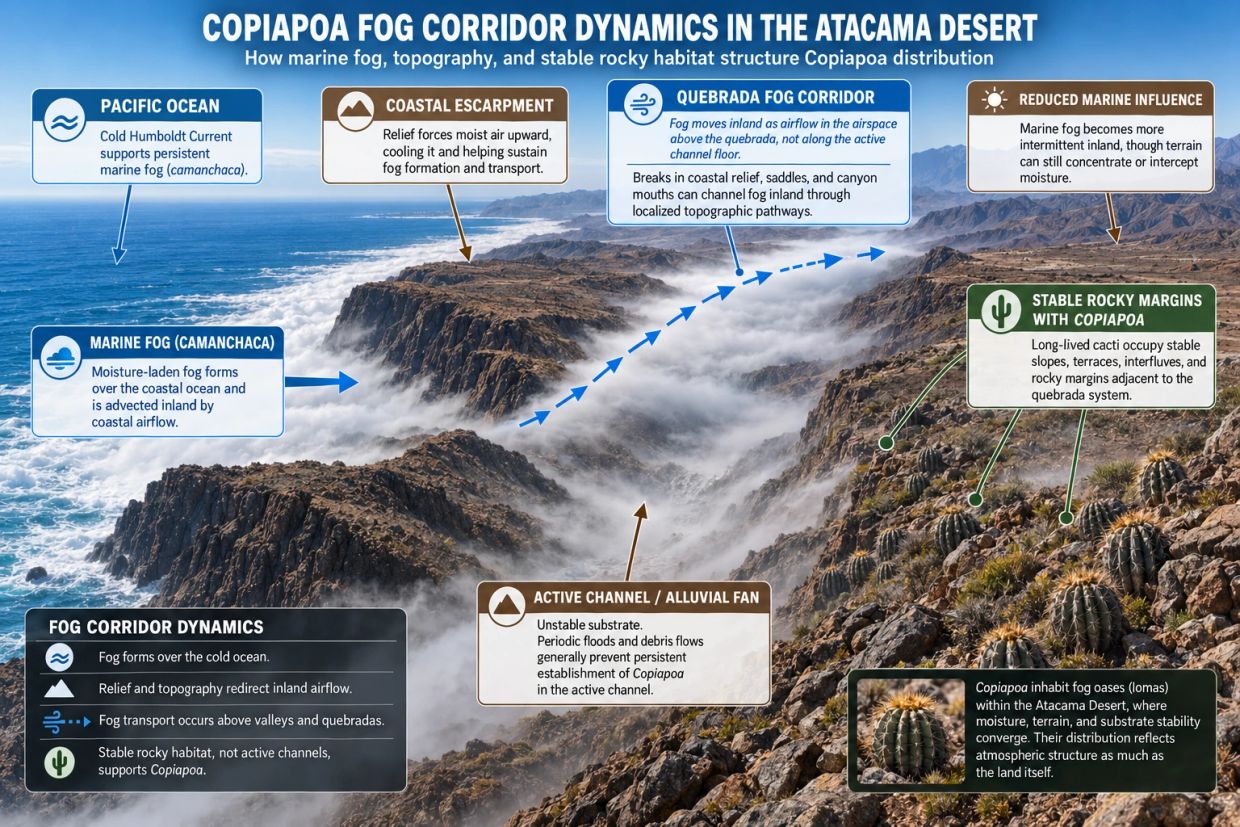
Flooding and substrate stability shape Copiapoa distribution
Geographic Anchors and Fog Oasis System
Geographic framework
To organize the distribution of Copiapoa across the Atacama Desert coastal range, this guide uses a five-level geographic framework:
- Fog Oasis System: the broader Atacama Desert coastal fog belt extending from southern Peru to north-central Chile
- Geographic Anchors: regional landscape systems representing recurring fog regimes, topographic structure, lithologic transitions, and moisture gradients
- Locality Populations: geographically identifiable populations, field-numbered collections, or documented collector localities within each anchor region
- Microlocality: a repeatable subpopulation setting within a locality population, such as a particular ridge, slope, terrace, fog-interception shoulder, or sector with a distinct combination of terrain and exposure.
- Microsite: immediate terrain position, including slope, aspect, ridge, terrace, drainage margin, substrate, and exposure
This structure reflects how Copiapoa populations occur in nature: not as isolated points, but as components of larger landscape systems in which environmental conditions can vary substantially even over short distances.
Why anchors are used
Attempting to catalog every microlocality across the Atacama Desert coast can obscure the broader ecological structure that governs Copiapoa distribution. The anchor system instead identifies recurring landscape systems within which locality populations can be interpreted.
These landscapes are not smooth environmental gradients. Much of the coastal Atacama Desert is deeply dissected by ridges, quebradas, saddles, side valleys, and overlapping slopes. Marine air moving across this terrain can be intercepted, redirected, concentrated, or blocked over remarkably short distances. As a result, two populations at nearly the same elevation and separated by only a few hundred meters can experience substantially different fog, solar radiation, wind, and moisture regimes.
Geographic anchors therefore represent three-dimensional landscape systems defined by the interaction of fog interception, topography, substrate, elevation, and distance from the coast. Elevation remains useful, but it cannot be interpreted independently of terrain position and exposure.
Anchors do not represent species boundaries and are not intended as exhaustive distribution maps. Each anchor encompasses multiple microhabitats and locality populations that may experience substantially different conditions within the same regional atmospheric system. Together, the anchors provide a stable geographic reference for interpreting locality records, phenotype variation, and ecological differentiation.
Fog oasis context
The broader fog-oasis framework underlying these anchors is informed by the remote-sensing analysis of Moat et al. (2021), who used a 20-year archive of MODIS satellite imagery to map desert fog oasis ecosystems along the Pacific coastal belt of Peru and Chile.
Their study identified more than 17,000 km² of fog-dependent vegetation distributed across more than 900 discrete fog oasis patches. These ecosystems occur as fragmented ecological islands shaped by elevation, slope, distance from the coast, atmospheric moisture interception, and the geometry of the coastal escarpment itself.
Along much of the Atacama Desert margin, the coastal cliff and Coastal Cordillera restrict farther inland movement of the marine stratocumulus layer. Where the escarpment is interrupted by quebradas or lower-relief corridors, fog can penetrate inland more effectively. GOES-based studies identified these corridors directly, and a later satellite-based climatology using machine learning techniques is consistent with their recurrence as landscape-scale features, with enhanced fog occurrence relative to adjacent unbroken escarpment sections. The strongest penetrations occur during austral winter advective events (Farías et al. 2005; Böhm et al. 2021).
The geographic anchors used here therefore reflect not only fog frequency at a given elevation, but also the topographic structure that determines where fog can reliably reach the land surface.
Quebradas as moisture corridors and ecological filters
Along the Atacama Desert coast, the Cordillera de la Costa rises steeply from the Pacific, intercepting the marine fog layer and limiting inland moisture movement. Where quebradas cut through this barrier, they create topographic corridors that allow Camanchaca to penetrate inland along narrow drainage profiles.
These corridors concentrate atmospheric moisture and help support fog-dependent vegetation, including Copiapoa, in terrain that would otherwise be too arid for establishment.
However, Copiapoa do not usually occupy active quebrada channels. Periodic debris flows, sediment movement, and mechanical disturbance make active channels unsuitable for plants whose individuals may persist for many decades to centuries. Instead, populations establish on stable rocky margins, abandoned terraces, cemented interfluves, and adjacent slopes where fog input coincides with long-term substrate stability.
This distinction is central: the quebrada is the fog pathway, but the plant habitat is the stable margin beside it. A drainage may channel abundant fog, but if its active floor is repeatedly reworked, Copiapoa cannot persist there.
Long-lived populations are therefore most likely to persist where sufficient atmospheric moisture overlaps with geomorphically stable rooting surfaces.
A useful general pattern is that the quebrada acts as a moisture pathway, while the most persistent Copiapoa habitat occurs on stable terrain beside or above the active channel.
This framework explains why Copiapoa often flank quebradas rather than occupy them directly. Their shallow, laterally spreading roots are adapted to rapid capture of surface moisture from fog, dew, and brief wetting events, but they require stable surfaces long enough for seedlings to reach a survival threshold. Field studies at Pan de Azúcar found that very small plants below approximately 1.5–2 cm were absent from surveyed populations, suggesting that early establishment is the main bottleneck.
The same corridor-margin pattern appears across much of the genus range, although the dominant moisture regime changes by latitude. In the northern hyper-arid core, quebradas such as Botija, Izcuña, El Médano, and San Ramón function primarily as fog conduits. Farther south, at sites such as Llanos de Challe and Huasco, quebradas still structure Copiapoa habitat, but within a fog-rainfall hybrid regime.
Near Tocopilla, populations thin out, likely reflecting reduced fog reliability among other contributing factors. Near Coquimbo, quebradas remain functional landscapes, but the dominant moisture regime shifts toward semi-arid rainfall rather than fog.
Together, these northern and southern limits bracket the functional fog-corridor system that structures most Copiapoa distribution. The quebrada model is therefore not simply a list of drainage names, but a way to understand how atmospheric moisture, topography, geomorphic stability, and plant longevity interact across the Atacama Desert.
Principal geographic anchors
The following anchors outline the primary environmental corridors that structure Copiapoa distribution along the Atacama Desert coast.
The quebradas listed under each anchor are not presented as simple habitat sites, but as landscape structures: fog conduits, drainage corridors, historical travel routes, and geomorphic filters.
Copiapoa populations generally occupy stable rocky margins, terraces, and interfluves associated with these systems rather than active channels.
- Tocopilla (Northern Perimeter)
- Located within the major Atacama Desert arid divide identified by Moat et al. (2021), a sector extending roughly from the Peru–Chile border to Antofagasta where verdant fog oases become sparse and fragmented, persisting only as small, isolated patches.
- Contributing Quebradas: Quebrada Barriles, Quebrada Mamilla. These drainages define the coastal escarpment structure at the northern distributional edge but Copiapoa tocopillana has not been reliably relocated in recent field surveys despite multiple attempts (Hoxey 2001, 2015). This anchor functions as a distributional boundary reference rather than a documented fog-corridor habitat.
- Quebrada Botija (High-Montane Environmental Reference)
- Within documented fog oasis terrain in the Paposo–Taltal corridor. Not individually resolved at the regional scale of Moat et al. (2021).
- Contributing Quebradas: Quebrada Botija (self-naming anchor). Copiapoa decorticans, C. ahremephiana, and C. solaris are documented within this drainage. El Medano style rock art confirms its use as a coast-to-interior corridor since at least the mid-Holocene (Monroy et al., FONDECYT 1151203).
- Blanco Encalada (Coastal Solaris Counterpoint)
- Within documented fog oasis terrain along the northern Chilean coastal belt. Not individually resolved in the regional MODIS mapping.
- Contributing Quebradas: Quebrada Izcuna. Copiapoa humilis subsp. variispinata grows in fragmented populations from the coast to 4.5-6.5 km inland along this quebrada, with subpopulations at higher altitudes receiving direct fog input (Ritter; llifle FK 382; Monroy et al., FONDECYT 1151203).
- Paposo (Northern Coastal Biodiversity Peak)
- Corresponds directly to the largest contiguous fog oasis complex documented in Chile by Moat et al. (2021), exceeding 610 km² and representing the highest concentration of fog oasis vegetation along the Chilean Atacama Desert coast.
- Contributing Quebradas: Quebrada El Medano, Quebrada de la Plata, Quebrada Paposo, Quebrada Matancilla, Quebrada Bandurrias. These drainages cut through the Cordillera de la Costa within this fog oasis complex. Aguadas within them support vegetation and historically supported livestock, confirming their role as fog conduits with permanent or seasonal water availability (Monroy et al., FONDECYT 1151203; Molina 2007a; Vidal Gormaz 1881).
- Taltal (Cinerea Type Locality)
- Located within the Paposo–Cifuncho fog oasis corridor, the most extensive contiguous fog oasis system documented in northern Chile by Moat et al. (2021). The Taltal region forms part of this larger coastal fog belt and represents the historical type locality for Copiapoa cinerea.
- Contributing Quebradas: Quebrada de Taltal, Quebrada Cascabeles, Quebrada San Ramon, Quebrada Portezuelo, Quebrada at Caleta Tortolas. Columna-alba populations occupy these quebradas running toward the Pacific, establishing within the drainage corridors but stopping short of the immediate beach zone (Monroy et al., FONDECYT 1151203; Molina 2007a; Hoxey 2004).
- Cerro Perales (Topographically Complex Fog Transition)
- Within the broader Paposo–Taltal atmospheric system, Cerro Perales illustrates why elevation alone cannot define Copiapoa habitat. Its deeply dissected massif contains ridges, opposing slopes, quebradas, and saddles capable of producing sharply different fog exposure over short distances.
- Contributing Quebradas: Cerro Perales lies within the upper Quebrada Taltal drainage system, with the summit overlooking Quebrada Taltal (Hoxey 2004). Historical records also document multiple aguadas and vegas associated with the massif, including Agua de Perales and the Las Tipias drainage on its southeastern flank. These features provide independent evidence of persistent hydrological structure but should not be interpreted as direct groundwater sources for Copiapoa. Field observations document substantial morphological variation among Copiapoa cinerea populations across the massif, making Perales an important example of localized ecological differentiation within a single geographic anchor.
- Esmeralda
- Within documented fog oasis terrain south of the Paposo complex. Not individually resolved at the regional mapping scale.
- Contributing Quebradas: Quebrada Guanillos (also rendered Huanillos on local signage), Quebrada Tigrillo. Both drain through the Esmeralda sector between Las Lomitas and the coast. Guanillos contains the full characteristic assemblage: C. longistaminea, C. grandiflora, C. esmeraldana, and C. laui (Hoxey 2003, 2010; KK 1385).
- Pan de Azúcar (Granitic Coastal)
- A major fog oasis biodiversity center with 293 recorded plant species in published surveys, representing the second highest documented diversity for any Chilean fog oasis region.
- Contributing Quebradas: Quebrada del Castillo, a named drainage within the national park where Copiapoa populations are documented along the trail system accessible from Camino C-110 (CONAF; Hoxey 2010).
- El Soldado Corridor
- Within documented fog oasis terrain between Pan de Azúcar and Chañaral. Not individually resolved at the regional MODIS scale.
- Contributing Quebradas: Quebrada La Madera (between Pan de Azucar and the Guanillos/Esmeralda sector). South toward Chanaral, the corridor is structured by short coastal drainages between Punta Animas, Los Toyos, Puerto Flamenco, Rada Blanca, and Punta Zentena. Unlike the Paposo or Taltal corridors, this sector is characterized by minor drainages across high-albedo, Miocene-stable interfluves rather than a dominant fog-channeling quebrada (Hoxey 2003, 2010).
- Chañaral–Copiapó Gateway (Phylogeographic Transition Zone)
- This corridor marks a major environmental transition between the northern Atacama Desert fog belt and the southern coastal desert systems. While fog oases persist farther south, the Chañaral–Copiapó region represents an important ecological and phylogeographic inflection point within Copiapoa, where fog influence weakens and the structure of the coastal desert begins to change.
- Contributing Quebradas: This anchor operates on different logic from the fog-corridor anchors further north. The Rio Copiapo is a broad fluvial valley functioning as a biogeographic filter, and the named quebradas here are Cordillera de Domeyko interior drainages: Quebrada La Encantada, Quebrada Dona Ines, Quebrada Patos Cerrados (now Jardin), Quebrada Chanaral Alto, Quebrada Paipote (Molina 2007a; San Roman 1896; Philippi 1860).
- Llanos de Challe (Southern Refuge)
- Classified as a transitional fog oasis system where fog-dependent desert vegetation grades into Mediterranean-type sclerophyllous communities at the southern ecological boundary of the Atacama Desert fog oasis system.
- Contributing Quebradas: Quebrada Mala, Quebrada Barracota. Within the national park, C. dealbata, C. echinoides, and Eulychnia breviflora are documented on low hills accessible from the ranger station (Hoxey 2010, 2013, 2019).
- Huasco / Carrizal Bajo (Southern Perimeter Reference)
- Corresponds to the southern ecological transition of the fog oasis system identified by Moat et al. (2021), marking the terminal extent of the primary Atacama Desert fog-dependent vegetation corridor.
- Contributing Quebradas: Quebrada Cruz Grande, Quebrada Honda, Quebrada de Los Hornos, Quebrada Juan Soldado (Aguilera 2014). Copiapoa fiedleriana is documented near Huasco (Hoxey 2013).
- Coquimbo (Southern Transition Reference)
- Located south of the primary Atacama Desert fog oasis system and outside the geographic scope of the Moat et al. (2021) mapping analysis.
- Contributing Quebradas: Quebrada Santa Gracia, Quebrada Marquesa (Soto et al. 2017). These drainages mark the southern transition where the fog-dominated moisture regime gives way to semi-arid rainfall. Like Tocopilla at the northern boundary, Coquimbo defines the genus range limit not by the absence of quebradas but by the transition of the moisture regime that gives them ecological meaning.
The Copiapó transition
The Chañaral–Copiapó sector corresponds to one of the most significant north–south transitions documented in the genus. Molecular phylogenetic analyses identify a major plastid clade division broadly corresponding to this sector, separating predominantly northern and southern evolutionary lineages.
This transition also coincides with a bioclimatic shift. North of Copiapó, conditions become increasingly hyper-arid, with stronger reliance on persistent marine fog and reduced inland moisture buffering. Southward, precipitation regime, vegetation structure, and substrate mosaics begin to shift.
Geomorphically, the Copiapó Valley forms a broad discontinuity within the coastal range. In its coastal sector, the valley widens substantially and is dominated by unstable sandy substrates. These conditions likely reduce connectivity between populations, particularly given the predominantly short-distance, ant-mediated seed dispersal reported for Copiapoa. Periodic flood events further limit long-term plant establishment across the valley floor.
The valley is not an absolute barrier. It functions as a soft biogeographic filter and coincides with one of the clearest phylogeographic inflection points within the genus.
For this reason, the Chañaral–Copiapó Gateway is treated here as a primary structural anchor in both ecological and evolutionary context.
Chañaral Conservation Concern
One additional variable in this corridor remains underexamined. Chañaral Bay carries one of the world’s most extensively documented marine mine-tailings contamination events, with approximately 150 million tons of copper mine tailings discharged directly into the bay during El Salvador mine operations from 1938 to 1990. Persistent sediment contamination continued after flood-resurgence events in 2015 and 2017.
Hydrochemical analyses of Camanchaca in the Chañaral sector demonstrate elevated concentrations of dissolved metals, including copper and arsenic, derived from coastal contamination sources (Bonnail et al. 2018). Because this fog is advected inland across the same coastal slopes that host Copiapoa populations, atmospheric deposition of dissolved metals via fog and associated aerosols represents a plausible but untested exposure pathway.
These findings indicate that Atacama Desert coastal fog systems are not uniformly chemically pristine. Localized anthropogenic contamination may create additional environmental pressure within specific coastal corridors.
Because long-term population stability in Copiapoa depends on successful recruitment rather than adult survival alone, even low-level contamination in fog-dependent systems could influence germination and early establishment without being immediately visible in standing adult populations. This mechanism is explored in greater detail in the Coastal Contamination and Fog-Mediated Transport section.
Floristic analysis and connectivity
Published floristic similarity analyses of the coastal Atacama Desert indicate strong affinity between Paposo and Taltal, supporting their interpretation as components of a coherent northern coastal fog-oasis system rather than isolated ecological units (Larraín Barrios 2007; Muñoz-Schick et al. 2001).
These analyses, based on Jaccard similarity indices, show greater floristic overlap between Paposo and Taltal than between Paposo and more southern fog-oasis systems. This similarity is consistent with their shared regional atmospheric setting, while local topography, elevation, exposure, and substrate create substantial ecological variation within the broader system.
Paposo is further distinguished by a high proportion of locally restricted taxa, supporting its designation as a regional biodiversity anchor despite the presence of endangered subpopulations.
In contrast, anchors such as Blanco Encalada and Quebrada Botija provide useful ecological counterpoints. Populations associated with Copiapoa solaris occur across markedly different coastal and high-elevation environments, allowing morphology, habitat, and associated rhizosphere ecology to be compared across contrasting moisture and exposure regimes.
Source Basis: Fog corridor structure and topographic channeling follow Farías et al. (2005), Böhm et al. (2021), and Moat et al. (2021). Archaeological and historical corridor use draws on Monroy et al. (FONDECYT 1151203) and Molina (2007a). Survival threshold and root architecture follow Gulmon et al. (1979). Floristic zonation follows Larraín Barrios (2007) and Muñoz-Schick et al. (2001). Phylogeographic context follows Larridon et al. (2015). The inference that mechanical recurrence in active channels excludes long-lived plants has not been experimentally tested for Copiapoa specifically. Full citations are on the Reference page.
The paradox of flooding in the hyper-arid Atacama Desert
The flooding that keeps Copiapoa from growing on active quebrada floors can seem paradoxical given how little rain reaches the Atacama coast. The answer lies upstream.
In the large quebradas that descend from the Andes to the Atacama coast, the flood water that scours the channel often originates far inland. Rainfall in the precordillera and at mid elevations, frequently during ENSO-linked or cutoff-low events, generates runoff that funnels down the drainage network and arrives near the coast hours later, sometimes under clear skies. Much like a flash flood in the Arizona desert, where a wash can run high and fast under a clear sky because the rain fell on distant mountains, a person standing at one of these quebrada mouths may never see the weather that produced the flood.
Smaller catchments in the Coastal Cordillera behave differently in this one respect. On the rare occasions they do run, their flows are fed by storms striking the coastal range directly, so a person standing in the drainage is usually experiencing the same weather that produces the runoff. The channel response is much the same either way, brief and sediment-charged, but the source of the water is not.
Why these floods are unusual - and powerful
These events differ from a typical Arizona wash in two ways that matter for plant habitat.
First, they are far rarer. The pattern appears to consist of moderate floods every few decades, punctuated by much larger events that may not recur for a century or longer. Long dry intervals allow loose sediment to accumulate in channels and valley fills. When a flood finally arrives, it does not simply move water downslope. It remobilizes years or decades of stored material, eroding its own bed and banks and sometimes widening the active channel substantially in a single event.
Second, many of the larger floods take the form of debris flows or highly sediment-laden runoff rather than simple muddy water. These dense mixtures of mud, sand, and rock carry enormous geomorphic force. The flows are also brief and intense. With little soil storage, almost no vegetation to slow runoff, and no sustaining baseflow, much of the water and channel reworking can pass in a matter of hours before the drainage returns to dry.
How the landscape builds over time
Each rare event delivers a large pulse of sediment that is deposited as the flow loses gradient and spreads near the coast. Over time, these deposits build the alluvial fans found at the mouths of many quebradas.
Importantly, the size of these fans is not evidence of frequent flow. They are the cumulative product of many rare, sediment-charged events spaced far apart in time. Between floods, material simply waits in the drainage system until the next major runoff event arrives.
In catchments affected by mining, that material is not always clean. Floods and debris flows can entrain mine tailings and metal-enriched substrate alongside natural sediment. Much of this material never reaches the ocean, instead being stored on alluvial fans and lower piedmont surfaces, where it may remain for decades before being redistributed by wind or future floods.
Why plants avoid the channels
Recovery from one of these events is slow. A major flood does not simply leave the channel dry again; it leaves it geomorphically disturbed. The time required for the channel to stabilize is long relative to the time a seedling needs to establish.
For long-lived desert plants such as Copiapoa, successful establishment requires a stable surface long enough for vulnerable seedlings to survive repeated dry periods. Even infrequent episodes of scouring, burial, and channel reworking can therefore strongly limit recruitment within active channels. This helps explain the recurring field pattern in which Copiapoa populations occupy terraces, slopes, and stable margins above the most frequently disturbed parts of the drainage.
The stable margins above the flood zone tell a different story. Terraces, slopes, and interfluves persist long enough for seedlings to survive the vulnerable establishment phase, which is why Copiapoa populations typically line the edges of quebradas rather than grow within them.
Ecotype Zone Framework and Evidence
For more than half a century, researchers, field explorers, and growers have documented strong geographic variation in Copiapoa across the Atacama Desert. Populations occupying different parts of the coastal landscape experience different combinations of marine fog, atmospheric humidity, solar exposure, temperature, terrain, substrate, and moisture availability.
Building on those observations, copiapoa.com uses a four-zone ecotype framework to organize the recurring environmental regimes encountered across the genus.
The framework integrates locality data with fog climatology, topography, hydrology, and other physical environmental evidence. It is intended to describe where a population sits within the Atacama Desert environmental system, not to assign a plant to a zone from its appearance.
This distinction has become increasingly important as locality-level comparisons have expanded.
Some phenotype characters repeat strongly within documented populations. Others overlap between zones or vary substantially within a single locality system. Elevation alone does not predict morphology, and neither pruina, body color, spination, growth form, nor clustering can independently identify an ecotype zone.
The four zones should therefore be understood first as environmental contexts.
Morphology is evaluated afterward.
Framework note
This ecotype framework is a working ecological model, not a taxonomic classification or morphological identification key.
Its purpose is to describe recurring atmospheric and landscape conditions that can help organize locality information, compare populations, and generate ecological hypotheses.
The framework is expected to evolve as higher-resolution fog data, locality evidence, geological information, physiological studies, and population-level genetic data become available.
Locality Data, Elevation Accuracy, and Fog-Bank Precision
Locality information, particularly elevation, is frequently approximate or inconsistently reported.
Descriptors such as “mountain form,” “coastal,” or “inland” may reflect terrain position or exposure rather than measured elevation and should not be treated as precise ecological indicators.
Accurate elevation requires direct measurement or reliable modern mapping.
Fog observations and satellite analyses document a persistent marine-inversion system along the Atacama Desert coast, but its ecological reach varies substantially with latitude, season, wind direction, and topography.
Quebradas can channel marine air inland. Ridges can intercept fog above neighboring slopes. Saddles can allow moisture-bearing air to cross otherwise restrictive terrain. Adjacent slopes at nearly identical elevations may therefore experience very different atmospheric conditions.
Elevation remains useful as a regional proxy for marine influence.
It is not an ecological boundary by itself.
Topography can be equally important.
The coastal Atacama Desert is deeply dissected by ridges, quebradas, side valleys, saddles, cliffs, terraces, and overlapping slopes. These features redirect fog, wind, radiation, and runoff over surprisingly short distances.
For that reason, ecotype interpretation should consider:
- regional atmospheric setting
- terrain position
- fog transport and interception
- slope and aspect
- distance from the coast
- substrate and drainage
- microlocality
- seasonal variability
A population's environmental setting is therefore reconstructed from multiple physical variables rather than elevation or morphology alone.
Hydrological Evidence Supporting Ecotype Zonation
Stable-isotope, hydrological, and fog-climatology studies indicate that moisture availability changes substantially across the coastal-to-inland gradient of the Atacama Desert.
Fog is particularly important within the coastal belt, while dew, condensation, rare precipitation, subsurface moisture, and other sources may become proportionally more important as reliable marine influence declines.
This broad gradient is strongly modified by terrain.
A favorable ridge or quebrada may receive meaningful atmospheric moisture farther inland than its elevation or distance from the coast would suggest, while an adjacent slope can remain comparatively dry.
The ecotype framework therefore describes recurring moisture environments, not simple horizontal bands.
Geochemical and microbiological studies also demonstrate that small quantities of biologically available moisture can persist within hyper-arid substrates through mechanisms such as mineral-associated condensation and retention.
Direct use of such mineral-bound water by Copiapoa has not been demonstrated, but these findings reinforce an important point: environmental water availability cannot be reduced to measured rainfall or visible fog alone.
Taken together, these lines of evidence support the existence of persistent atmospheric and hydrological gradients across Copiapoahabitat.
They do not establish a fixed corresponding sequence of plant morphologies.
Environmental structure operates alongside inherited variation, population history, gene flow, developmental response, and microsite.
🔴 Scientific anchor: Ecotype describes the environmental setting in which a population occurs. Phenotype is biological evidence interpreted within that setting, not the criterion used to define it.
Quick Reference: Ecotype Zones
The four zones summarize recurring environmental regimes before each is examined in greater detail.
Zone 1: Coastal Fog Belt
Environmental pattern: persistent or highly reliable marine influence, frequent fog or low cloud, relatively high atmospheric humidity, and strong coastal temperature moderation.
Phenotype: strong pruina is common in some populations, but there is no single calibrated Zone 1 morphology. Body form, clustering, spination, epidermal color, and wax expression can vary considerably among coastal localities.
Zone 2: Transitional Fog Belt
Environmental pattern: intermittent but significant marine influence. Fog exposure becomes increasingly dependent on season, airflow, slope, terrain position, and microlocality.
Phenotype: high variability is characteristic of the documented populations examined so far. Grey-green bodies, variable pruina, strong or moderate spination, and globose to short-columnar growth all occur, but none independently defines Zone 2.
Zone 3: Inland Fog-Shadow
Environmental pattern: regional marine influence is less reliable, although favorable ridges, saddles, quebradas, and exposed terrain can still intercept significant atmospheric moisture.
Phenotype: compact, dark, or heavily spined forms occur in some inland settings, but they are not diagnostic. Calibrated inland locality systems also contain pale-bristled, exposed-waxed, grey, green, and contrasting spine expressions within the same broader geographic setting.
Zone 4: High Montane
Environmental pattern: predominantly above or beyond reliable marine-fog influence, with severe moisture limitation, strong direct radiation, colder nights, wind exposure, and large thermal variation.
Phenotype: characteristic morphology remains insufficiently calibrated. Extremely compact growth, reduced rib expansion, recessed apices, bronze or olive pigmentation, and rigid spination may occur, but the present governed locality dataset is not sufficient to define these traits as a Zone 4 phenotype.
These zones describe broad environmental regimes rather than fixed elevation bands or morphological classes.
Local topography, aspect, exposure, substrate, hydrology, and atmospheric structure can shift equivalent conditions higher or lower and create broad overlap between zones.
Source Basis: Fog frequency and broad atmospheric structure follow Cereceda et al. (2008), Thompson et al. (2003), Moat et al. (2021), and related Atacama Desert fog climatology. Elevation is treated as a regional proxy whose ecological significance depends on terrain position and exposure. Phenotype interpretations reflect calibrated locality comparisons developed for this project and are intentionally separated from the environmental definitions of the zones.

Coastal fog is the lifeline of the Atacama Desert
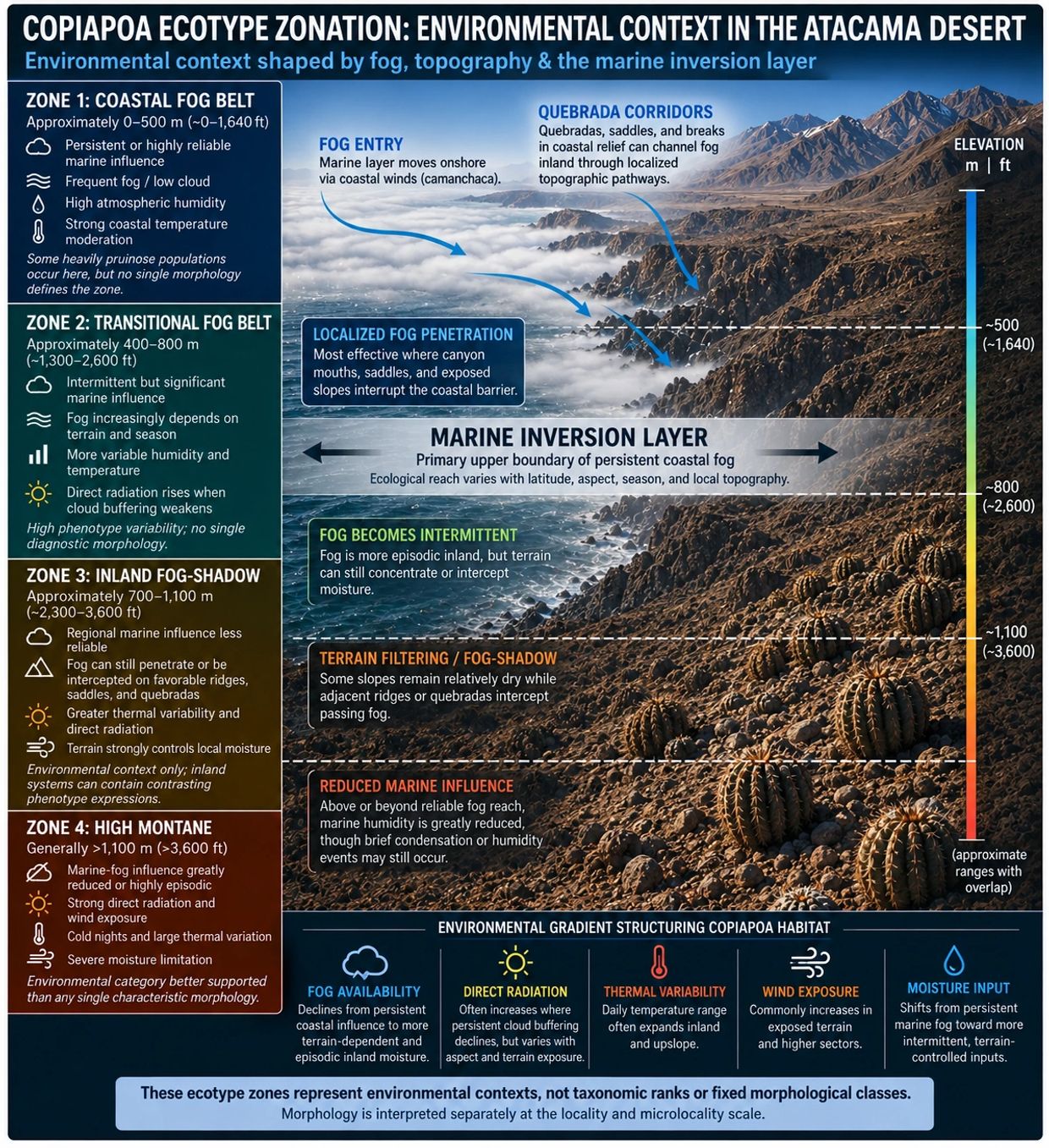
Ecotype Zones Definitions
➤ Zone 1: Coastal Fog Belt, approximately 0–500 m
Environmental context:
Zone 1 occupies strongly marine-influenced sectors of the Atacama Desert coast. Fog frequency and atmospheric humidity are generally high, although the altitude of maximum fog interception varies substantially with latitude and terrain.
Strong maritime influence can extend nearly to sea level in exposed coastal sectors, while the greatest fog-water interception may occur hundreds of meters higher on favorable slopes.
Climatic context:
Coastal air is comparatively humid and thermally moderated. Fog and low cloud can strongly reduce incoming solar radiation for part of the day, while clearing conditions can expose plants to intense direct radiation.
At Las Lomitas, Jung et al. (2020) recorded a mean PAR of 892.72 ± 727.53 µmol/m²/s and a maximum of 2,596 µmol/m²/s, illustrating the large variation possible even within a fog-influenced environment.
Phenotype interpretation:
Strong epicuticular pruina occurs in several well-documented coastal populations and may be especially conspicuous where heavy wax-producing lineages occur.
It is not universal.
The current calibrated locality evidence does not support defining Zone 1 by a fixed combination of broad ribs, soft epidermis, compact growth, short spines, or heavy wax.
Those traits may occur, but their presence or absence does not determine Zone 1 assignment.
Primary anchors: Paposo, Blanco Encalada, El Soldado Corridor, Pan de Azúcar, Chañaral–Copiapó Gateway, and Llanos de Challe, specifically their strongly marine-influenced sectors.
➤ Zone 2: Transitional Fog Belt, approximately 400–800 m
Environmental context:
Zone 2 occupies the transition where marine influence remains ecologically important but becomes less continuous and increasingly dependent on slope exposure, airflow, cloud height, terrain, and season.
Fog may remain frequent in favorable positions while nearby slopes experience substantially longer dry intervals.
Climatic context:
Atmospheric humidity remains influenced by the coastal system but becomes more variable. Direct radiation and diurnal temperature variation generally increase as continuous maritime buffering weakens.
Phenotype interpretation:
The calibrated dataset supports high phenotypic variability within transitional environments.
Grey-green bodies, variable pruina, globose and short-columnar growth, and moderate to strong spination all occur.
These characters also occur outside Zone 2 and should not be used as zone markers.
The environmental transition is more reliable than any single corresponding morphology.
Primary anchors: Taltal, Paposo, Esmeralda, Pan de Azúcar, and Llanos de Challe, specifically their transitional sectors.
➤ Zone 3: Inland Fog-Shadow, approximately 700–1,100 m
Environmental context:
Zone 3 occupies landscapes where regional marine influence is substantially less reliable.
Fog may still penetrate through quebradas or cross saddles, and exposed ridges can intercept atmospheric moisture even where surrounding terrain lies largely within a fog shadow.
Humidity events therefore become increasingly episodic and terrain-dependent rather than disappearing at a uniform elevation.
Climatic context:
Direct radiation and thermal variation generally increase, while dependable atmospheric moisture becomes less frequent. Local terrain can nevertheless create substantial exceptions to the regional pattern.
Phenotype interpretation:
Dark epidermis, compact bodies, dense spination, and reduced visible pruina occur in some inland populations.
They do not define Zone 3.
Calibrated observations from Cerro Perales and the San Ramón system demonstrate that markedly different expressions can coexist within the same broader inland landscape, including dense pale-bristled plants and more exposed, waxed forms.
Zone 3 should therefore be recognized from environmental context rather than from a presumed dark or heavily spined morphology.
Primary anchors: Cerro Perales and inland sectors associated with the Taltal and Esmeralda landscape systems.
➤ Zone 4: High Montane, generally above approximately 1,100 m
Environmental context:
Zone 4 represents high and strongly inland terrain where dependable marine-fog influence is greatly reduced.
Plants may experience intense direct radiation, strong winds, cold nights, large daily thermal variation, and very limited moisture availability.
Nighttime humidity or brief condensation events may still occur near the upper margin of the marine atmospheric system, particularly where topography favors cooling or interception.
Lithic moisture context:
Mineral substrates may condense, retain, or redistribute trace moisture within fractures and shallow rooting environments.
Whether this contributes materially to Copiapoa water balance remains unresolved.
Phenotype interpretation:
Very compact growth, recessed apices, bronze or olive coloration, reduced rib expansion, and rigid spination have been associated with high and strongly exposed environments.
At present, however, the calibrated wild-locality dataset does not contain enough independent high-montane observations to define these as characteristic Zone 4 traits.
The environmental category is better supported than its proposed phenotype.
Primary references: Quebrada Botija and high sectors of the broader coastal range where marine influence becomes minimal. These should be treated primarily as environmental references until stronger population-level phenotype calibration is available.
Summary
From Zone 1 to Zone 4, the framework describes a broad transition from environments with frequent maritime moisture and strong coastal atmospheric moderation toward increasingly episodic humidity, stronger direct radiation, greater thermal variability, and more severe moisture limitation.
That environmental gradient is real.
The corresponding morphology is not a fixed sequence.
Population history, inherited variation, terrain, substrate, microlocality, and individual growth conditions interact with the broader atmospheric regime, producing overlapping phenotype envelopes across the four zones.
The practical hierarchy is therefore:
environmental zone → locality population → microlocality → microsite → phenotype envelope → individual expression
not:
plant appearance → ecotype zone
Note on overlaps and anchors
Numerical elevation ranges overlap intentionally.
They describe broad regional tendencies rather than boundaries.
Slope orientation, terrain position, latitude, wind exposure, cloud height, and local atmospheric structure can move similar environmental conditions substantially higher or lower across the Atacama Desert landscape.
Geographic Anchors likewise do not represent single ecotypes. An anchor can contain multiple locality populations and microlocalities occupying different environmental settings within the same larger landscape system.
Ecotype Zone Map
The interactive Copiapoa Ecotype Zone Map illustrates broad coastal fog influence, transitional environments, inland fog-shadow conditions, high-montane settings, and localized terrain effects.
The map should be read as an environmental framework rather than a morphology map.
It helps identify the physical context in which a documented population occurs. Phenotype, provenance, locality history, and microlocality are then interpreted as separate layers of evidence.

Geologic mosaic underlying Copiapoa Atacama Desert habitat
Cross-Elevation Modifiers
Ecotype zones describe broad environmental regimes. Within any zone, local conditions can change sharply because of terrain, substrate, exposure, drainage, and microsite.
These local factors are best treated as cross-elevation modifiers.
They do not redefine ecotype identity, and they do not predict a fixed phenotype. Instead, they change the physical conditions experienced by a population or individual plant.
Important modifiers include:
- surface albedo and heat retention
- rooting depth and fracture structure
- drainage and short-term moisture retention
- slope and aspect
- wind exposure
- terrain-controlled fog interception
- surface stability
- localized nutrient inputs
- mineral chemistry
These factors can vary independently of elevation.
A pale granitic slope and a dark volcanic outcrop at similar elevation may experience different surface temperatures. A ridge and adjacent quebrada may receive different fog exposure. A stable terrace and an active drainage margin may differ in their ability to support long-lived plants even when atmospheric conditions are similar.
The environmental differences are measurable. Their effects on morphology must be evaluated population by population.
A useful way to read the framework is:
- Atmosphere establishes the regional moisture regime.
- Terrain controls where that moisture is delivered and intercepted.
- Substrate modifies heat, drainage, rooting conditions, reflectivity, and local moisture behavior.
- Inherited variation and population history constrain phenotype.
- Microlocality captures the repeatable subpopulation-scale environmental setting, while microsite describes the immediate terrain position experienced by an individual plant.
Together, these factors create the environmental context in which a population develops. No single layer should be treated as sufficient to explain phenotype by itself.
🔴 Principle: Read substrate as environment, not as a phenotype code.
Geology, Albedo, and Substrate Memory
The Atacama Desert fog-oasis system operates across an unusually persistent geological template. Minimal rainfall, low erosion rates, and long-term landscape stability have preserved exposed mineral surfaces and landforms over immense timescales, in some areas extending back into the Miocene.
This stability extends beyond the bedrock itself.
In the hyper-arid Atacama Desert, salts, dust, atmospheric compounds, and biological inputs can accumulate because they are not regularly removed by rainfall, deep leaching, or rapid biological turnover. Soil development therefore occurs very differently from wetter environments, and ancient surfaces can preserve chemical and physical characteristics for extremely long periods (Ewing et al. 2006). The result is a landscape in which geological boundaries often remain sharply expressed at the surface.
Granitic material, volcanic rock, mineralized zones, caliche, alluvium, talus, and other substrates can occur in close proximity while differing substantially in reflectivity, heat storage, drainage, rooting structure, and moisture behavior.
🔴 Startling observation: At many points along the Atacama Desert coast, the geological surface visible today has changed remarkably little over timescales far longer than the lifespan of any individual plant.
This persistence makes geology an important part of the long-term environment experienced by Copiapoa populations. It does not mean geology determines phenotype.
A substrate that remains physically stable over many generations can impose a persistent thermal, hydrological, and rooting environment. Whether that environmental difference produces a repeatable difference in pruina, pigmentation, spination, ribs, or growth form must be demonstrated from the plants themselves.
Short-term observation can also be misleading.
Fog varies with season and time of day, and the visible surface may not represent the material surrounding the roots. A plant appearing to grow in pale alluvium may be anchored into darker bedrock beneath it, while fractured rock may retain moisture differently from the loose surface material around it.
Substrate interpretation should therefore distinguish between:
- visible surface material
- underlying bedrock
- rooting medium
- surface albedo
- thermal behavior
- fracture structure
- drainage and moisture retention
These are physical habitat variables. Their biological consequences should be tested rather than assumed.
Thermal Albedo and Microclimate
One of the clearest ways substrate can influence the immediate environment is through its interaction with solar radiation.
Pale, high-albedo surfaces reflect a greater proportion of incoming radiation. Dark, low-albedo surfaces generally absorb more energy and can re-radiate that heat after direct solar exposure declines. The resulting difference can alter the thermal environment around stems and shallow roots.
Surface reflectivity can also change the direction and intensity of radiation reaching the sides and underside of a plant, while rock size, porosity, fractures, and surface structure can affect airflow and moisture retention.
These effects make substrate biologically relevant even without assuming a particular morphological outcome. A plant on pale granitic material may experience a different combination of reflected radiation and substrate temperature than a neighboring plant rooted among dark volcanic rocks.
Likewise, two visually similar substrates can behave differently if one is fractured and moisture-retentive while the other is compact and rapidly drying.
For this reason, thermal albedo is best treated as a measurable microclimatic variable rather than a phenotype class.
The term Thermal Albedo Effect can therefore remain useful if it refers specifically to the way substrate reflectivity and heat storage alter the plant's local radiation and temperature environment. It should not imply that pale substrate produces pale plants or that dark substrate produces dark plants.
Morphological Response: Spines, Wax, Ribs, and Pigment
Spines, pruina, rib structure, epidermal characteristics, and pigmentation all have functional relevance to the extreme radiation and thermal environment experienced by Copiapoa. Experimental and physiological studies across cacti show that spine density, orientation, surface reflectivity, rib geometry, and epidermal properties can influence stem temperature, radiation interception, boundary-layer conditions, and physiological performance.
In Copiapoa, these functions provide a strong reason to investigate morphology in relation to habitat. They do not establish a simple one-to-one relationship between a particular substrate and a particular phenotype.
Our calibrated locality comparisons show that several conspicuous traits overlap across contrasting environments and can also vary within the same broader locality system.
Heavy true pruina occurs in populations at different elevations and environmental settings. Dark and pale-spined expressions can occur within the same broader geographic system. Similarly, body color, clustering, and growth form cannot be predicted reliably from substrate class alone.
This does not make substrate irrelevant. It means that the causal chain is more complex.
Persistent differences in radiation, temperature, moisture, rooting environment, and exposure may contribute to long-term selection or developmental expression. At the same time, inherited variation and population history constrain how plants can respond. Phenotype should therefore be interpreted as the result of interacting influences rather than as a direct surface map of geology.
The useful sequence is:
physical substrate → measurable microclimate → population response hypothesis → observed phenotype
not:
rock type → predicted plant appearance
Where repeated phenotype differences coincide with independently documented substrate differences, that association becomes a testable ecological pattern. Until that comparison has been made, geology should be treated as environmental context rather than proof of morphological cause.
🔴 Principle: Rock can change the environment around the plant. Whether it changes the plant in a predictable way must be demonstrated.
Surface Constraints and Rooting Environments
Surface conditions can strongly influence where Copiapoa are able to establish and persist.
Rooting depth, fracture structure, drainage, substrate stability, and access to short-lived surface moisture can vary sharply over very short distances. These differences may determine whether a seedling finds a stable rooting site even where the broader atmospheric environment appears suitable.
Surface constraints are therefore important components of habitat interpretation. They should be distinguished from direct explanations of phenotype.
Caliche crusts
Caliche is a hardened crust formed through long-term accumulation and cementation of soluble minerals under strongly evaporative conditions.
In the Atacama Desert, extensive caliche surfaces can create severe physical restrictions on rooting. Dense crusts offer few penetrable sites, while fractures, margins, discontinuities, and pockets of looser material provide localized opportunities for establishment.
Large caliche surfaces occur in sectors of the Chañaral–Caldera corridor, interior basins near Llanos de Challe, and ancient coastal terraces south of Pan de Azúcar. In these settings, Copiapoa may become concentrated around fractures and other breaks in the crust. The ecological importance of caliche is therefore primarily as a rooting and surface-stability constraint.
It may influence drainage, salt exposure, and moisture behavior locally, but the presence of caliche should not be used to predict body color, pruina, spination, or growth form.
Talus and scree slopes
Steep talus slopes, cliffs, and unstable scree can increase heat exposure, reduce soil depth, and impose mechanical instability. Fog exposure depends strongly on slope aspect, terrain position, and airflow.
Plants in these settings may show leaning or creeping growth while anchoring into fractured rock rather than stable soil. Strong outward or reflexed spines, thickened cuticles, reinforced ribs, and slow growth may also occur in these environments. Examples include talus-grown Copiapoa cinerea, cliff-bound C. solaris and C. serpentisulcata, and scree-based C. bridgesii.
These forms provide useful examples for examining how mechanical instability, thermal exposure, limited rooting opportunity, and inherited population characteristics may interact within the broader environmental framework.
Lithologic Contact Zones
Where contrasting geological units meet, physical habitat conditions can change abruptly over very short distances. A pale alluvial surface may border darker bedrock. Fractured granite may meet denser volcanic material. Drainage, rooting depth, thermal behavior, reflectivity, surface stability, and moisture retention may all change across the same boundary.
These contact zones are therefore valuable natural comparison sites.
If plant phenotype also changes across a geological contact, that coincidence can identify a potentially important ecological association. It does not establish that geology caused the morphological difference.
Several other variables may change across the same short distance, including slope, aspect, fog interception, wind exposure, rooting structure, and population history.
Lithologic boundaries are therefore most useful when treated as independent physical controls that can be compared against documented plant populations and microlocalities.
The appropriate sequence is:
identify geological contact → characterize physical differences → document populations on each side → test whether phenotype also changes
rather than:
geological contact → assume phenotypic change
Mineral composition may also influence local soil chemistry and plant stress, but direct links between specific mineral assemblages and visible Copiapoa traits remain insufficiently demonstrated.
🔴 Principle: A geological boundary can mark a real environmental transition. Whether it also marks a biological transition must be shown by the plants.
Localized Nutrient Modifiers
Most cross-elevation modifiers act through heat, reflectivity, rooting depth, or substrate stability. Biogenic nutrient islands operate differently. They do not change ecotype or define morphology directly; instead, they may locally modify growth conditions where nutrient sources, fog transport, and suitable rooting surfaces overlap.
Guano and biogenic nutrient islands
While most of the Atacama Desert is mineral-dominated and biologically sparse, certain coastal cliffs and headlands function as localized biogenic nutrient islands due to persistent seabird activity over late Pleistocene to Holocene timescales. In this hyper-arid environment, minimal precipitation, limited microbial turnover, and slow organic decomposition allow biogenic inputs to accumulate and persist, producing nitrogen- and phosphorus-enriched microsites distinct from surrounding mineral substrates.
The Humboldt Current sustains high marine productivity and large seabird colonies, whose long-term guano accumulation represents one of the few enduring biological nutrient subsidies in the coastal Atacama Desert. These inputs originate from marine trophic cycling and carry a distinct chemical and isotopic signature not present in terrestrial desert systems. Seabird guano from northern Chilean rookeries shows extremely elevated nitrogen isotope values (δ¹⁵N averaging ~23‰), producing levels of enrichment far beyond what aridity or natural soil processes can generate (Santana-Sagredo et al.). In fog-exposed Copiapoa habitats near former rookeries and historic guano extraction sites, roots may occur in proximity to guano-enriched debris and altered soil microbiomes, locally increasing nutrient availability.
Coastal fog (Camanchaca) interacting with these enriched surfaces can entrain dissolved nitrogenous compounds and aerosols. In Copiapoa, spine-mediated capture of atmospheric moisture is functionally integrated with internal water transport, allowing intercepted water to move from the plant surface into the stem.
Biogenic inputs may therefore contribute to nutrient availability both through localized deposition to the rhizosphere and through plant-surface interception. In this way, any nutrient contribution is incremental and occurs only where fog already provides reliable hydration.
These effects are spatially constrained, typically limited to areas near active or historic seabird colonies, and diminish rapidly with distance. Guano enrichment therefore operates as a localized modifier rather than a landscape-scale driver of these systems.
The spatial structure of this process can be difficult to visualize from text alone. In coastal systems such as Guanillos, the interaction between fog transport, topography, and localized nutrient sources occurs over very short distances. The conceptual model below illustrates how these elements converge at the mouth of the quebrada.
Several historic guano localities illustrate this context. Guanillos (Huanillos) refers to more than one coastal site in northern Chile and must be carefully distinguished: the Tarapacá cliff system in the far north and the Antofagasta coastal cove near Cifuncho belong to different geographic and ecological settings and should not be conflated. Additional representative localities include Pabellón de Pica and Punta Gruesa. In some guano-influenced settings, nitrophilous lichens (e.g., Xanthoria spp.) occur on surrounding rock surfaces, providing a visible field indicator of localized nitrogen enrichment within otherwise mineral-dominated fog-oasis habitats.
Biogenic nutrient islands should therefore be understood as contextual modifiers of growth potential within fog-supported ecotypes, not as primary drivers of Copiapoa distribution, ecotype formation, or taxonomic differentiation.
Geologic substrate mosaic across the Atacama Desert fog belt
This sample geologic map segment, based on the Mapa Geológico de Chile (SERNAGEOMIN 2003), illustrates the mineral and structural mosaic underlying Copiapoa habitat.
The map was developed for geological and mineral mapping, not plant ecology, but it provides a useful physical layer for reconstructing habitat.
Across much of the coastal Atacama Desert, extreme aridity and limited soil development leave bedrock, alluvium, mineralized surfaces, caliche, and other geological units unusually exposed. As a result, official geological mapping can help identify changes in substrate, surface structure, drainage, and potential thermal behavior over short distances.
These boundaries matter because different substrates can create different physical environments.
They may differ in:
- surface reflectivity
- heat absorption and release
- fracture density
- rooting opportunity
- drainage
- moisture retention
- surface stability
- mineral chemistry
Geological mapping can therefore help identify where meaningful microclimatic transitions may occur.
It cannot, by itself, predict the phenotype of the Copiapoa growing there.
Map units such as Qa, Jag, Dc4, granitic intrusions, volcanic units, and mineralized zones should be treated as physical habitat layers to compare with independently documented plant populations, not as morphological classes.
Where repeated phenotype differences coincide with geological boundaries, the association can then be tested using locality, terrain, atmospheric exposure, and replicated plant observations.
The appropriate sequence is:
map geology → characterize physical environment → compare documented populations → test phenotype association
not:
map geology → predict plant appearance
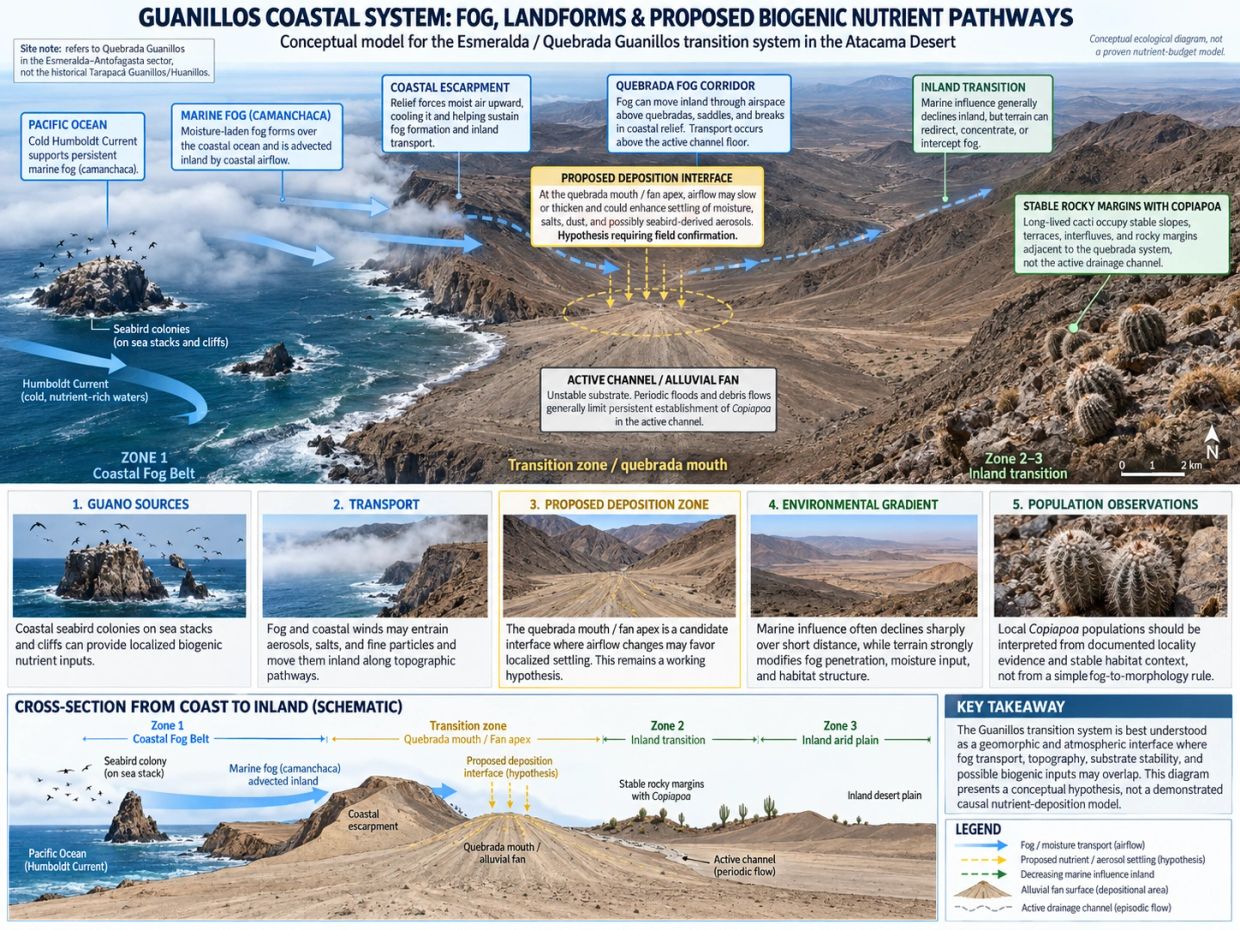
Topographic corridors and fog penetration
Where coastal escarpments are interrupted by quebradas or low-relief terrain, fog can penetrate inland more effectively. These breaks act as localized pathways for moisture movement, concentrating fog along drainage mouths and adjacent slopes.
In guano-influenced systems, this same pathway can transport dissolved nutrients and aerosols over short distances. The result is a tightly constrained zone where fog, topography, and nutrient input intersect, typically limited to coastal interfaces and diminishing rapidly inland.
Substrate Classes and Microclimatic Effects
The following substrate classes summarize several recurring physical environments found within Copiapoa habitat.
They are not phenotype categories.
➤ Reflective Surfaces: Light Granitic and Alluvial Substrates
Representative map units: Qa, CPg, TRg, Klag.
Quartz-rich granitoids, pale alluvium, and other high-albedo surfaces can reflect a substantial portion of incoming solar radiation. This may reduce heat storage within the substrate while increasing reflected radiation around the plant itself. The resulting microenvironment can differ substantially from that of adjacent darker rock even under the same atmospheric conditions.
Other important variables include grain size, rooting depth, fracture structure, drainage, and the thickness of loose material above bedrock.
Pale substrates therefore provide a useful physical environmental category.
Current calibrated locality evidence does not establish that they reliably produce pale epidermis, stronger pruina, yellow spines, or columna-alba morphology.
Where those associations appear to occur, they should be treated as locality-specific patterns requiring independent confirmation.
➤ Heat-Retentive Surfaces: Dark Volcanic, Metamorphic, and Sedimentary Substrates
Representative map units: Jag, J3l, Dc4, MP1c.
Dark volcanic, metamorphic, and some sedimentary surfaces generally absorb more incoming radiation than pale reflective substrates and can re-radiate stored heat after direct solar exposure decreases. This can increase thermal load around shallow roots and stems.
Rock mass, porosity, fracture structure, orientation, wind exposure, and shading can all modify the effect, so dark color alone does not determine substrate temperature.
These surfaces are therefore useful as indicators of potentially different thermal environments. They should not be treated as predictors of dark epidermis, dense spination, reduced pruina, or compact growth.
Our calibrated comparisons make this distinction particularly important at Cifuncho and Esmeralda. Cifuncho includes heavily pruinose documented plants at substantially different elevations, while the independent Esmeralda lineages examined to date repeat a grey-green, lightly pruinose phenotype rather than a consistent melanistic expression.
➤ Strongly Mineralized Surfaces
Iron- and copper-rich mineralized zones can create visually distinctive substrates and may differ from surrounding terrain in albedo, heat storage, chemistry, fracture structure, and salt accumulation.
These environments are particularly relevant in historically mineralized sectors of the Atacama Desert. Mineral chemistry may influence plant physiology locally, but direct mechanisms linking particular mineral concentrations to Copiapoa pigmentation or spine expression have not been established.
Dark plants occurring in mineralized terrain therefore do not demonstrate that mineralization caused the phenotype.
The useful ecological question is whether independently documented populations show repeatable differences that remain associated with mineralized substrates after other variables such as fog exposure, terrain position, radiation, and population history are considered.
Until that comparison is made, mineralization remains an important environmental variable rather than a phenotype mechanism.
➤ Geological Contact Zones
Where contrasting geological units meet, the physical environment can change abruptly.
A pale alluvial surface may border dark bedrock. Fractured granite may meet dense volcanic material. Drainage, rooting depth, thermal behavior, reflectivity, and surface stability can change within a short distance. These contacts are therefore valuable natural test sites.
If plant phenotype also changes across the boundary, the geological transition provides a hypothesis to test, not proof of causation. This distinction is important for localities such as the Tigrillo–Las Lozas corridor, where apparent changes in plant expression have been associated with geological transitions.
The appropriate interpretation is:
observed phenotype change near geological contact → candidate physical association
not:
geological contact → demonstrated phenotype flip
How Cross-Elevation Modifiers Fit the Four-Zone System
Cross-elevation modifiers describe physical conditions that can vary within any of the four environmental zones. A Zone 1 locality may contain reflective alluvium, dark bedrock, stable terraces, and fractured slopes. The same is true in Zones 2, 3, and 4.
These substrate differences can change:
- thermal load
- reflected radiation
- drainage
- rooting opportunity
- surface moisture behavior
- substrate stability
- local nutrient availability
What they do not provide is a reliable formula for plant appearance.
A dark volcanic substrate does not automatically imply a dark plant. Pale granite does not automatically imply heavy pruina. A geological contact does not automatically produce an intermediate or contrasting phenotype. Instead, geology becomes most informative when it is compared with repeated observations from documented locality populations and microlocalities.
That approach allows a distinction between:
physical association, where geology and phenotype repeatedly coincide,
and
causation, which requires stronger independent evidence.
🔴 Principle: Use geology to identify environmental contrasts worth testing. Do not use it to predict phenotype before looking at the plants.
Conceptual model of fog-mediated nutrient transport in a coastal alluvial fan system (Guanillos)
Geomorphic setting (alluvial fan geometry, coastal cliff, and quebrada structure) based on Walk et al. (2019). Seabird guano accumulation at coastal rookeries provides a localized nutrient source.
Transport of dissolved nitrogen compounds and fine particulates via fog (Camanchaca), and their deposition at the quebrada mouth and upper fan slopes, is presented as a proposed mechanism consistent with short transport distances of approximately 1.2 km and established fog dynamics, but has not been directly measured in this system.
This model illustrates how biogenic inputs can function as localized modifiers within fog-supported ecotypes, influencing growth conditions without altering the underlying ecological structure.
Why Copiapoa Cinerea Stands Alone
Copiapoa cinerea is among the most ecologically wide-ranging lineages in the genus. It spans persistent coastal fog belts, drier interior transitions, and higher slope environments. This broad habitat amplitude helps explain several otherwise puzzling features of the complex: extraordinary phenotypic diversity, the historical proliferation of locality and form names including columna-alba and krainziana, consistently low genetic divergence reported in molecular studies, and a comparatively more stable conservation outlook relative to narrow endemics such as Copiapoa laui, Copiapoa esmeraldana, and Copiapoa tenuissima.
The diversity within Copiapoa cinerea is best interpreted as geographically structured variation within a lineage occupying a wide range of environmental settings rather than as widespread recent hybridization or a series of sharply separated species.
Environment clearly matters, but the relationship is not one of simple zone-to-morphology correspondence.
Our locality comparisons show that some phenotype characters repeat strongly within documented populations, while others overlap between environmental zones or vary substantially within the same broader locality system. Fog regime, terrain, substrate, radiation, and microsite interact with inherited variation and population history to produce the phenotype observed in habitat.
Molecular phylogenetic sampling shows that Copiapoa cinerea and its columna-alba and krainziana forms constitute a lineage with low detected divergence, supporting interpretation of these forms as geographically structured expressions rather than sharply separated species (Larridon et al. 2015). Nuclear microsatellite analyses in Larridon et al. 2018 similarly found that more than 90% of detected genetic variation occurred within named taxa rather than between them.
The 2025 Sarnes monograph further documents extensive morphological variation across habitat populations.
Together, these lines of evidence support a model in which geography, inherited variation, population history, and environmental setting must be interpreted together.
Why two plants labeled Copiapoa cinerea may differ
Two plants both sold as Copiapoa cinerea can look remarkably different.
One may be heavily pruinose with pale spines. Another may be dark, densely spined, green, grey, strongly clustering, or nearly solitary.
Neither appearance, by itself, identifies the plant's ecotype or locality. The differences are better understood through several interacting layers.
First: provenance and locality
A documented locality establishes where a population occurs. That provides the geographic framework within which fog exposure, terrain, elevation, substrate, radiation, and other environmental variables can be reconstructed.
Provenance therefore comes before morphological interpretation.
A cultivated plant of uncertain parentage may express traits inherited from multiple populations or undocumented crosses. Without reliable origin information, morphology can still be studied, but it cannot securely be connected to a particular wild population.
Second: environmental context
The ecotype framework describes the broad atmospheric and hydrological setting occupied by a population. Coastal, transitional, inland fog-shadow, and high-montane environments differ in moisture reliability, marine influence, radiation, temperature, and exposure.
Those differences create meaningful ecological context. They do not prescribe a fixed morphology.
The calibrated Perales and San Ramón observations demonstrate this especially clearly. Pale-bristled, densely spined plants and more exposed, waxed expressions can occur within the same broader inland landscape system.
A Zone 3 setting therefore cannot be defined simply by dark epidermis, reduced pruina, or dense dark spination.
Third: microlocality and substrate
Within the same broader locality, terrain position and substrate can alter the physical conditions experienced by a population. Ridges, saddles, quebradas, opposing slopes, reflective alluvium, dark bedrock, fractured rock, and stable terraces can differ in fog interception, radiation, thermal load, drainage, rooting opportunity, and moisture retention.
These are important environmental differences. They do not provide a reliable formula for predicting body color, pruina, spine tone, or growth form.
Substrate should therefore be read as physical habitat evidence, not as a phenotype code.
Fourth: population phenotype
Once locality and environmental context are established, morphology becomes biologically informative. Repeated traits among independently documented plants can define a population phenotype envelope.
That envelope may include tendencies in pruina, body color, spination, growth form, clustering, or other characters. The envelope is not absolute. Individual plants can vary, neighboring microlocalities can differ, and similar traits can occur in geographically separate populations.
The useful sequence is therefore:
provenance → locality → environmental context → microlocality → population phenotype → individual expression
not:
appearance → ecotype → assumed locality
When these layers are known, differences between cinerea populations become more interpretable. They do not become completely predictable.
From Framework to Practice: Collector Guidance
The ecological framework is most useful as a way to organize evidence, not as a recipe for producing a particular appearance in cultivation.
➤ Start with provenance
Establish the best available locality information first.
Field number, collector records, elevation, terrain position, and other original documentation should remain separate from later ecological interpretation.
A plant without reliable provenance should not be assigned to a locality from resemblance alone.
➤ Reconstruct the environment
Use locality to investigate the environmental regime in which the
population occurs.
Relevant variables include:
- marine fog influence
- terrain-controlled fog interception
- elevation
- slope and aspect
- solar exposure
- temperature
- substrate
- drainage
- microlocality
The ecotype zone provides broad environmental context, but the individual locality and microlocality provide the finer ecological resolution.
➤ Treat substrate as a physical modifier
Substrate can alter heat load, reflectivity, drainage, rooting environment, and local moisture behavior. These effects can be significant. They should not be converted automatically into predictions of pigmentation, pruina, or spination.
A pale substrate does not necessarily produce a pale plant. A dark substrate does not necessarily produce a dark one. Where substrate and phenotype repeatedly coincide across documented populations, the association becomes a hypothesis worth testing.
➤ Use phenotype as evidence, not provenance
Compare the plant with documented wild material from the same population where possible. Repeated morphology can help define the expected phenotype envelope of that population and can reveal meaningful differences among localities and microlocalities.
Phenotype cannot establish missing locality data.
➤ Habitat informs cultivation
Habitat reconstruction can identify useful starting hypotheses for cultivation. Fog exposure, radiation, temperature, drainage, substrate behavior, and moisture availability can suggest which conditions deserve attention.
But habitat does not automatically provide an exact cultivation prescription.
Light, temperature, water use, substrate temperature, growth response, epidermal condition, and other variables should be measured and adjusted directly under cultivation. The goal is not to force a plant into a predetermined ecotype appearance. It is to understand the environmental history of the population and then evaluate how the plant responds under cultivation.
➤ Functional biology: living mineral matrix
In habitat, Copiapoa roots exist within biologically active mineral substrates rather than sterile media. Metagenomic sampling of Copiapoa solaris rhizosphere communities across the Quebrada Botija corridor documents differences in microbial community structure and stress-response gene abundance among populations separated by relatively short geographic distances (Cayo et al. 2025).
These findings make soil biology a potentially important part of Copiapoa ecology. They do not establish that recreating a particular microbial community is necessary to reproduce habitat morphology or successfully cultivate a particular ecotype. That remains a separate biological and cultivation question.
🔴 Principle: Start with provenance, reconstruct the environment, observe the
population, then test cultivation against the plant itself.
Copiapoa cinerea Distribution and Reference Localities
This map presents a schematic overview of the Copiapoa cinerea lineage complex across the Atacama Desert coastal range, emphasizing major geographic sectors, recurring population expressions, and key reference localities.
Polygon boundaries are schematic visualization bands and do not represent surveyed range limits.
Copiapoa gigantea occupies the northern range sector from roughly the Quebrada Izcuña area south toward Paposo, where coastal rocky slopes support some of the lineage's most massive columnar expressions. It is shown here as a related expression within the broader cinerea framework, noting its comparatively more distinct clustering signal in nuclear analyses (Larridon et al. 2015).
Copiapoa cinerea sensu stricto is centered on the Taltal coastal massif, the historical type region for the complex. Populations across this landscape occupy a range of coastal, slope, and inland settings and provide an important geographic reference for understanding variation within the lineage.
The krainziana form of Copiapoa cinerea is associated with the Taltal–San Ramón–Perales landscape system. Current evidence supports treating it as a geographically structured expression within the cinerea lineage rather than as a sharply genetically separated species.
Within that landscape, however, phenotype is not uniform. The Perales and San Ramón comparisons indicate substantial microlocality-level heterogeneity, so krainziana-type morphology should not be reduced to a single environmental zone or elevation band.
The columna-alba form occupies the southern portion of the cinerea range toward Chañaral and includes populations with conspicuous pruina and other distinctive morphological expressions.
Those repeated traits are valuable population-level characteristics. Their presence should not be attributed solely to granitic substrate, insolation, or any other single environmental variable without independent evidence demonstrating that relationship. Together, these expressions illustrate why plants within the Copiapoa cinerea complex can differ substantially while remaining closely related. Locality and population history provide the geographic framework.
Environmental context helps explain the conditions under which the population occurs. Phenotype is then interpreted as an additional biological layer rather than used to reconstruct origin.
Source Basis: Low genetic divergence within the cinerea complex follows Larridon et al. (2015, 2018). Habitat photography and geographic variation follow Sarnes (2025). Rhizosphere community structuring follows Cayo et al. (2025). Phenotype interpretations incorporate the calibrated locality comparisons developed in this project.
Practical Interpretation for Collectors and Conservation
The framework presented in this guide, environmental zones, geographic anchors, locality populations, microlocalities, substrate, and phenotype envelopes, converges on a small number of practical principles.
Provenance first
No amount of morphological analysis can substitute for reliable provenance. A plant with documented locality, collector number, and seed history can be interpreted within its geographic and environmental context.
A plant without that information cannot be converted into documented locality material regardless of how closely it resembles a known population. When provenance is missing, say so. “Unknown origin” is more useful than a confident but unsupported locality.
Do not confuse variation with hybrid ancestry
Unusual or intermediate morphology does not by itself demonstrate hybrid origin. Documented populations can contain substantial variation, and neighboring microlocalities can support contrasting phenotype expressions.
Before proposing hybrid ancestry, compare the plant with documented population material and consider provenance, geography, population variation, and other independent evidence.
Morphology can raise the question. It cannot answer it alone.
Do not confuse habitat plants with habitat seed
A wild-collected plant growing in cultivation is a habitat plant. Seed produced by that plant in cultivation is not habitat-collected seed unless its collection history justifies that description.
Open pollination in mixed collections can introduce undocumented ancestry. Seed provenance therefore requires the same care as plant provenance.
Label uncertainty honestly
When origin is unclear, traits appear inconsistent, or documentation is incomplete, label the plant conservatively. “Suspected hybrid,” “uncertain origin,” or “cultivated seed, parent locality X” are more informative than assigning a confident identity unsupported by documentation.
Honest labeling protects cultivated seed lines and preserves the value of well-documented material.
Use the evidence layers together
No single variable explains Copiapoa morphology on its own.
The Geographic Anchor provides the regional landscape context.
The Locality Population establishes the documented population.
The ecotype zone describes the broad environmental regime.
The Microlocality captures terrain-controlled differences within the locality.
Substrate modifies thermal, hydrological, and rooting conditions.
The phenotype envelope records the range of biological expression actually observed in the population.
Interpretation is strongest when these layers are kept distinct and then compared. It is weakest when elevation, zone, substrate, appearance, or any other single variable is treated as sufficient by itself.
Closing principle
Records establish origin. Environment establishes context. Phenotype describes the plant. None should be substituted for another.
The interactive Copiapoa Distribution Map below applies this framework across the range of the genus, showing Geographic Anchors, environmental structure, locality systems, and other geographic layers used throughout this guide.

The amazing diversity of Copiapoa cinerea